Summary
# Video Summary: Accounting Crash Course - Be Job Ready in 1.5 Hours!
### One-Sentence Summary
This comprehensive video provides a complete beginner's guide to accounting, covering fundamental concepts, the rules of debit and credit, key accounting principles, and the step-by-step preparation of financial statements through practical examples.
### One-Paragraph Summary
Hosted by **Learn Accounting Finance**, this 1.5-hour crash course is designed to take viewers from zero knowledge to job-ready proficiency in accounting. The video begins by defining accounting as the "language of business" and explains the double-entry system, emphasizing that every transaction has two consequences: a debit and a credit. It details the five core elements of accounting—Assets, Liabilities, Equity, Income, and Expenses—providing definitions based on International Financial Reporting Standards (IFRS) and distinguishing between current and non-current classifications. The instructor then outlines essential accounting principles such as accrual, matching, going concern, and materiality. The latter half of the video focuses on practical application, walking through nine specific journal entries for a fictional company ("Bold Bikes") and demonstrating how these entries flow into the General Journal, General Ledger, and Trial Balance, ultimately leading to the preparation of the Balance Sheet, Income Statement, and Cash Flow Statement.
### Key Takeaways
* **Double-Entry System:** Every financial transaction must have at least one debit and one credit, and the total debits must always equal total credits.
* **The Accounting Equation:** Assets = Liabilities + Equity. This equation must always balance.
* **Rules of Debit and Credit:**
* **Assets & Expenses:** Increase with a Debit; Decrease with a Credit. (Mnemonic: **IDEA** - Increase Debit Expense Assets).
* **Liabilities, Equity, & Income:** Increase with a Credit; Decrease with a Debit.
* **Financial Statement Components:**
* **Balance Sheet:** Reports Assets, Liabilities, and Equity at a specific point in time.
* **Income Statement (P&L):** Reports Income and Expenses over a period of time to determine Net Income.
* **Cash Flow Statement:** Tracks cash inflows and outflows categorized into Operating, Investing, and Financing activities.
* **Key Accounting Principles:**
* **Accrual Principle:** Record transactions when they occur, not when cash is exchanged.
* **Matching Principle:** Match expenses to the revenues they help generate in the same period.
* **Going Concern:** Assume the business will continue operating indefinitely.
* **Materiality:** Immaterial items (small amounts) can be expensed immediately rather than capitalized.
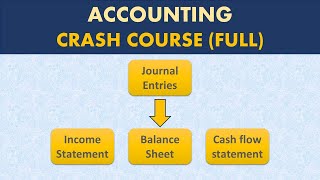
* **Accounting Cycle:** The flow of data is Journal Entries $\rightarrow$ General Ledger $\rightarrow$ Trial Balance $\rightarrow$ Financial Statements.
### Important People/Entities
* **Channel/Author:** Learn Accounting Finance
* **Standards Body:** International Financial Reporting Standards (IFRS)
* **Example Company:** Bold Bikes Company (used for practical examples)
* **Real-World Example:** Nike (used to illustrate real financial statements)
### Notable Timestamps
* **01:02** - What is accounting? (The language of business)
* **02:30** - What are debits and credits? (Double-entry concept)
* **05:14** - Rules of Debit and Credit (The "IDEA" mnemonic)
* **09:04** - What is an Asset? (Definition and examples)
* **10:23** - What are IFRS? (Global accounting standards)
* **19:12** - Current vs. Non-Current Assets
* **24:45** - What is a Liability? (Accounts payable, accrued liabilities)
* **30:49** - What is Equity? (Assets minus Liabilities)
* **34:31** - Income and Expenses (Definitions and impact on equity)
* **40:34** - Accounting Principles (Accrual, Matching, Going Concern, Materiality)
* **53:58** - Practice Accounting Entries (9 practical examples)
* **1:09:47** - Flow of Accounting Entries (Journal to Ledger to Trial Balance)
* **1:17:28** - Financial Statements (Balance Sheet, Income Statement, Cash Flow)
* **1:18:07** - Balance Sheet Preparation
* **1:19:30** - Income Statement Preparation
* **1:22:37** - Cash Flow Statement Preparation (Direct and Indirect methods)