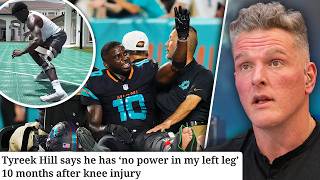
Summary
# Video Summary: Tyreek Hill's Injury and Future in the NFL
**One-Sentence Summary**
Former NFL cornerback Nnamdi Asomugha (referred to as "Hawk" in the transcript, likely a misidentification by the speaker or a specific guest nickname, but contextually referring to a former player/expert analyzing speed) discusses Tyreek Hill’s recent admission of having "no power" in his injured leg, suggesting that without his elite speed and quickness, Hill’s career may be in jeopardy due to the increasing size of modern NFL cornerbacks.
**Paragraph Summary**
The discussion centers on Tyreek Hill’s recent video statement revealing he still lacks power in his leg following a gruesome injury. The guest argues that Hill’s entire value proposition in the NFL is built on his explosive speed and quickness, which allowed him to evade defenders regardless of coverage. The guest posits that if Hill cannot return to his pre-injury physical state, he may need to "reinvent himself," but notes that at 5'8", he lacks the physical stature to compete as a traditional "body position" receiver against today’s taller, longer defensive backs. The conversation highlights how the NFL has evolved, with cornerbacks now averaging 6'1" to 6'5" (compared to 5'10" in the past) to counter large receivers like Calvin Johnson and Randy Moss. Consequently, the guest suggests that Hill’s elusiveness is his primary weapon, and without it, his effectiveness will significantly diminish, potentially jeopardizing his career or forcing a return to the Kansas City Chiefs if he cannot adapt.
**Key Takeaways**
* **Hill’s Injury Impact:** Tyreek Hill admitted to having no power in his injured leg, raising concerns about his ability to return to his previous level of play.
* **Speed is Critical:** For a receiver of Hill’s height (5'8"), speed and quickness are his primary competitive advantages; without them, he cannot rely on physical matchups or jump balls.
* **Evolution of NFL Defenses:** Cornerbacks have grown significantly in size (now often 6'1"+) to combat larger receivers, making it harder for shorter, elusive receivers to win one-on-one matchups without elite speed.
* **Reinvention vs. Decline:** The guest believes Hill must either reinvent his game or face a significant decline, as there is no other successful archetype for a 5'8" receiver in the modern NFL who isn't reliant on speed.
* **Chiefs Connection:** There is speculation about Hill potentially returning to the Kansas City Chiefs, which could be a viable path if he struggles to adapt elsewhere.
**Important People/Entities**
* **Tyreek Hill:** NFL Wide Receiver, Miami Dolphins (mentioned as potentially returning to Chiefs).
* **Nnamdi Asomugha / "Hawk":** Former NFL Cornerback and analyst (referred to as "Hawk" in the transcript, likely a guest on *The Pat McAfee Show*).
* **Devin Hester:** Former NFL return specialist, cited as the greatest returner in history.
* **Aaron Donald:** Former NFL Defensive Tackle, used as a comparison for maintaining high performance levels even at reduced capacity.
* **Calvin Johnson, Randy Moss, Terrell Owens:** Legendary NFL receivers cited as reasons for the increase in cornerback size.
* **Deion Sanders:** NFL legend, quoted regarding the desire for taller corners (6'1" and 6'2").
* **The Pat McAfee Show:** The media outlet hosting the discussion.
**Notable Timestamps**
* **00:00 - 00:28:** Introduction of Tyreek Hill’s video statement regarding his lack of power in his injured leg and the question of whether he can return to his former self.
* **00:29 - 01:18:** Analysis of Hill’s speed as his primary advantage and the difficulty for a 5'8" receiver to succeed without it.
* **01:19 - 02:20:** Comparison of Hill’s explosiveness to Devin Hester and Aaron Donald, noting that even at 80% capacity, Hill remains elite.
* **02:21 - 03:30:** Discussion on the physical mismatch between shorter receivers and the increasingly taller NFL cornerbacks (6'4"-6'5").
* **03:31 - 04:12:** Explanation of how the NFL evolved to counter large receivers, leading to the current need for speed and elusiveness to beat taller, less agile defenders.